
Scaling P3 — How Space Beach Grew from a Closed Boeing Plant
Public-private partnerships don't have to be limited to single projects. A panel at the 88 Cities Fall Summit examined how Long Beach used the P3 approach to turn the end of C-17 manufacturing into the aerospace cluster known as Space Beach.
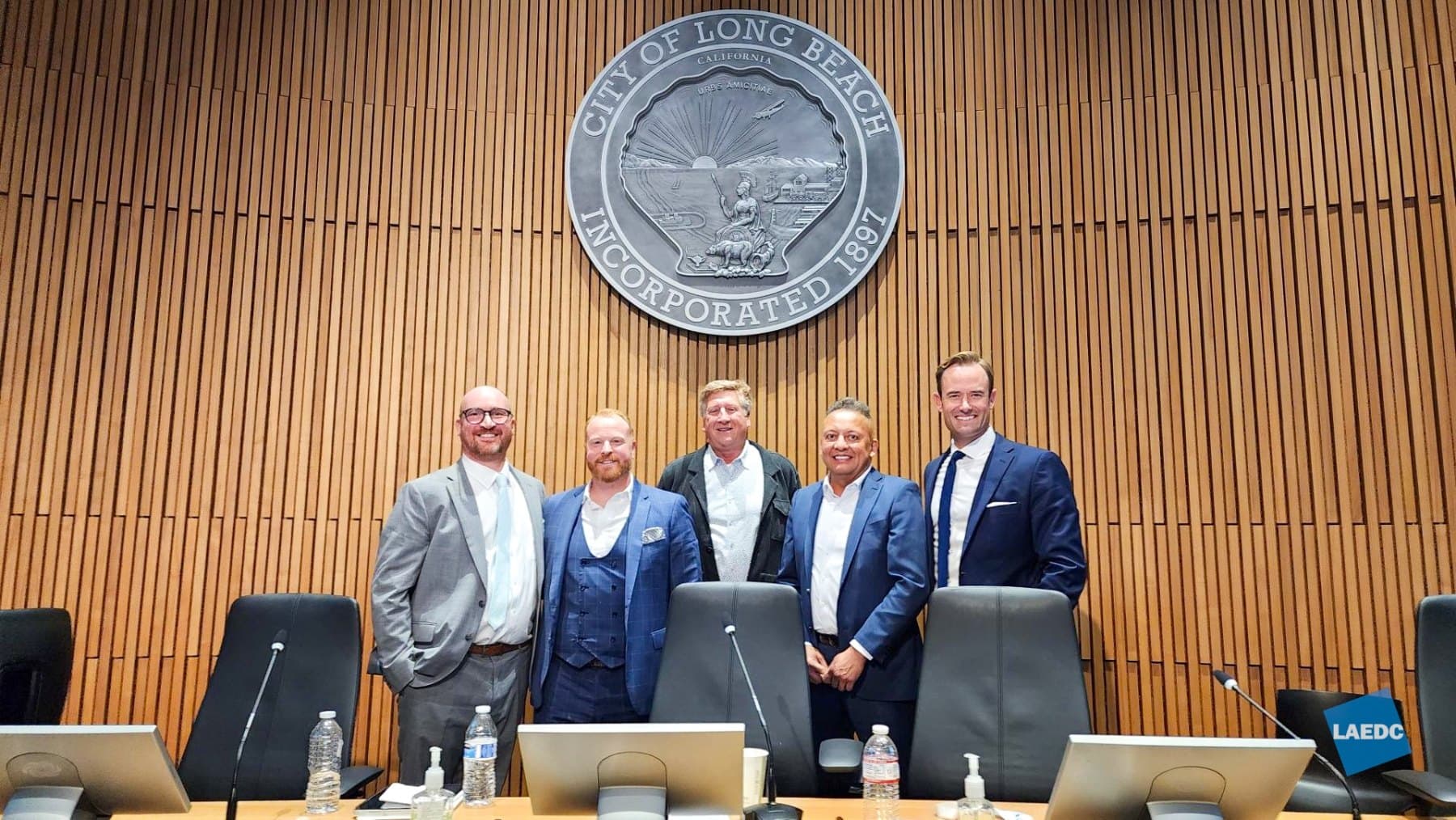
Public-private partnerships don't need to be limited to single projects. The concept can be central to an entire economic development approach, such as the Long Beach cluster development of Space Beach.
That was the topic of a panel at the recent 88 Cities Fall Summit in Long Beach. The Los Angeles County Economic Development Corporation organized the summit.
The "Scaling Public-Private Partnerships" panel was moderated by Studio One Eleven partner Michael Bohn, and included Sunstone Cities CEO John Keisler, City of Long Beach Economic Development Director Bo Martinez, Long Beach Economic Partnership Board Chair Weston LaBar, and Advocacy Chiefs LLC CEO Benjamin Cadranel.
The panel's subtitle was "From funding resilience to industry cluster development," and the panelists agreed that the transition from the end of commercial airplane manufacturing to a large and successful group of outer space-oriented companies is a shining example of that approach.
Historic Ending
Long Beach had been building airplanes for 74 years when Boeing delivered its last C-17. The aerospace legacy stretched back to before World War II when Douglas Aircraft settled in the city next to the municipal airport.
Manufacturing of commercial jets had stopped several years before the U.S. government announced it wouldn't order any more of the giant cargo planes known as C-17s. When Boeing shut the line down, approximately 1,410 jobs were lost directly and regional losses were estimated at 5,191 jobs. For perspective, Douglas Aircraft employed 50,000 people during World War II.
The giant C-17 construction plant was only part of the Boeing manufacturing property that now was surplus. An earlier master plan called Douglas Park transformed former Boeing facilities into an area of retail, open space — and headquarters for Virgin Galactic.
Virgin Galactic and its Launcher One arrived as Boeing was closing its C-17 hangar doors in 2015. By 2018 Virgin — now called Virgin Orbit — employed about 450 people. The venture eventually folded, but it was the pioneer that started Space Beach.
Government Support
With Boeing's early warning in 2013 that it would close the C-17 plant in 2015, Long Beach officials went to work. In September 2015, the U.S. Department of Defense's Office of Economic Adjustment awarded Long Beach a $3,995,609 grant as part of a $4.4 million comprehensive economic transition program tied to the end of the C-17 program.
It was the first big piece of public participation in the P3 project of Space Beach.
Keisler was the director of the city's Economic Development Department at the time. As he recalled during the panel discussion, the city used the grant for economic development, land use and infrastructure planning, along with assistance to impacted defense suppliers.
Building on the Douglas Park Planned Development, the city created a "Globemaster Corridor Specific Plan" that provided a comprehensive framework for developing 437 acres in the north-central portion of Long Beach. The development districts did not include any residential component — it focused on industrial, commercial and airport-related development.
That plan was approved by the City Council in 2021, but it had been in the works since 2014, after Boeing announced its manufacturing closure. That planning was key, but the business-friendly approach of Long Beach's government representatives to attracting companies and making their move to Space Beach as easy as possible also was important.
Both Keisler and his successor, Bo Martinez, said the Economic Development Department functioned under the philosophy of rolling out the red carpet, not the red tape. Walking potential new tenants through the regulatory maze — including regulations imposed by state and federal governments — was standard operating procedure.
More Public Partners
While available land and both financial and bureaucratic assistance was critical to the space companies looking to join Space Beach, a key factor was — and is — a qualified work force. While the legacy of aviation provided a base, cutting-edge approaches require cutting-edge training and education.
As Boeing manufacturing wound down and workers were let go, the Pacific Gateway Workforce Innovation Network stepped in. They connected displaced Boeing workers with new opportunities, found and supported training programs (including programs at Long Beach City College), and provided high-quality career services.
Many of the new jobs created by these space companies involved aerospace engineering. California State University, Long Beach, had just the thing. CSULB was ranked #4 nationally among public universities for aerospace engineering and has built one of the largest aerospace programs in the state. Just last year, CSULB received a $15 million federal grant to upgrade its engineering facilities.
Continued workforce development will be key for the cutting-edge companies of Space Beach to continue to grow. The partnership is synergistic — students find valuable internships at these companies, some of which also support the school financially for things like the Beach Rocket Lab.
P3 Works
The success of this Public-Private-Education Partnership can be seen in the roster of major companies calling Long Beach home.
Relativity Space is leasing the entire 1-million-square-foot former Boeing C-17 facility for its headquarters and manufacturing center for its launch vehicle — built largely with metal 3D printers.
SpinLaunch, a company developing a kinetic launch system using centrifugal force to throw rockets into space, moved its headquarters from Sunnyvale to Long Beach.
Rocket Lab, a well-established small satellite launch and manufacturing company, came to Long Beach to consolidate its corporate headquarters, production complex, and mission control center.
Vast Space, which is developing the first privately built space station, moved into the northern portion of the Globemaster Corridor, and has plans to launch its Haven-1 in mid-2026.
The gorilla in the space room, SpaceX, doesn't have a place in Space Beach proper, but it does have a booster recovery facility at the Port of Long Beach.
Numerous smaller companies focusing on specific segments of the space and aviation industry have joined Space Beach to be part of the ecosystem. Focuses stretch from Orbital Operations' work to create an extended space vehicle with capability to move to problem areas on command to Wisk, an autonomous air taxi company affiliated with Boeing.
Other firms focused on advanced technology are part of the Space Beach area around the Long Beach Airport. Mercedes-Benz was among the first, taking over the Boeing 707 facility to be its development and prep center. Nikon Advanced Manufacturing Technology Center opened last year, and Ford's Electric Vehicle Development Center opened this summer.
In every case, the P3 approach had a hand in companies locating in and near Space Beach. In many cases, an argument could be made that the additional jobs would not have come to Long Beach without P3.
And jobs have come. It is estimated that 6,000 workers are directly employed by aerospace today — up from 2,800 aerospace jobs in 2018.
That's economic development.
News Briefs
The University of California, San Francisco began construction in August 2025 on a major public-private project for an advanced oncology and life sciences laboratory facility, serving as an anchor for the Dogpatch Power Station redevelopment in San Francisco.
Garden Grove is delivering a new civic center, including a police headquarters, parking garage, and park, through a progressive P3 model targeting urban revitalization and public safety needs.
A 20-acre housing P3 near the College of San Mateo will build approximately 100 affordable units, with an advisor selected this month to help structure the risk-sharing arrangement.
The P3 Summit in New York (September 2025) convened more than 80 global CEOs and senior government leaders to reshape public-private partnerships for current economic and societal needs, signaling a trend toward more ambitious, cross-sector partnerships worldwide.
In San Diego, the Metropolitan Transit System is launching a major P3 effort to expand its network, including a goal of transitioning to a 100% zero-emission bus fleet.
Sources
Long Beach Business Journal, "The storied history of Douglas Park" — https://lbbusinessjournal.com/business/news/the-storied-history-of-douglas-park/
Los Angeles Times, on the Boeing C-17 closure — https://www.latimes.com/business/la-fi-boeing-long-beach-20130919-story.html
Los Angeles Times, on Virgin Galactic in Long Beach — https://www.latimes.com/business/la-fi-virgin-long-beach-20150213-story.html
MyNewsLA, on the Department of Defense grant — https://mynewsla.com/government/2015/09/28/u-s-department-of-defense-awards-long-beach-3-9m-to-find-ways-to-repurpose-old-boeing-site/
City of Long Beach, Globemaster Corridor Specific Plan legislation record — https://longbeach.legistar.com/LegislationDetail.aspx?ID=4942567
California State University, Long Beach, Space Beach Initiative — https://www.csulb.edu/space-beach-initiative