Public-Private-Education Partnership Creates Long Beach Accelerator
How John Shen, John Keisler, and Dr. Wade Martin combined private capital, city support, and university expertise to build the Long Beach Accelerator — one of the first public-private-education partnerships of its kind.
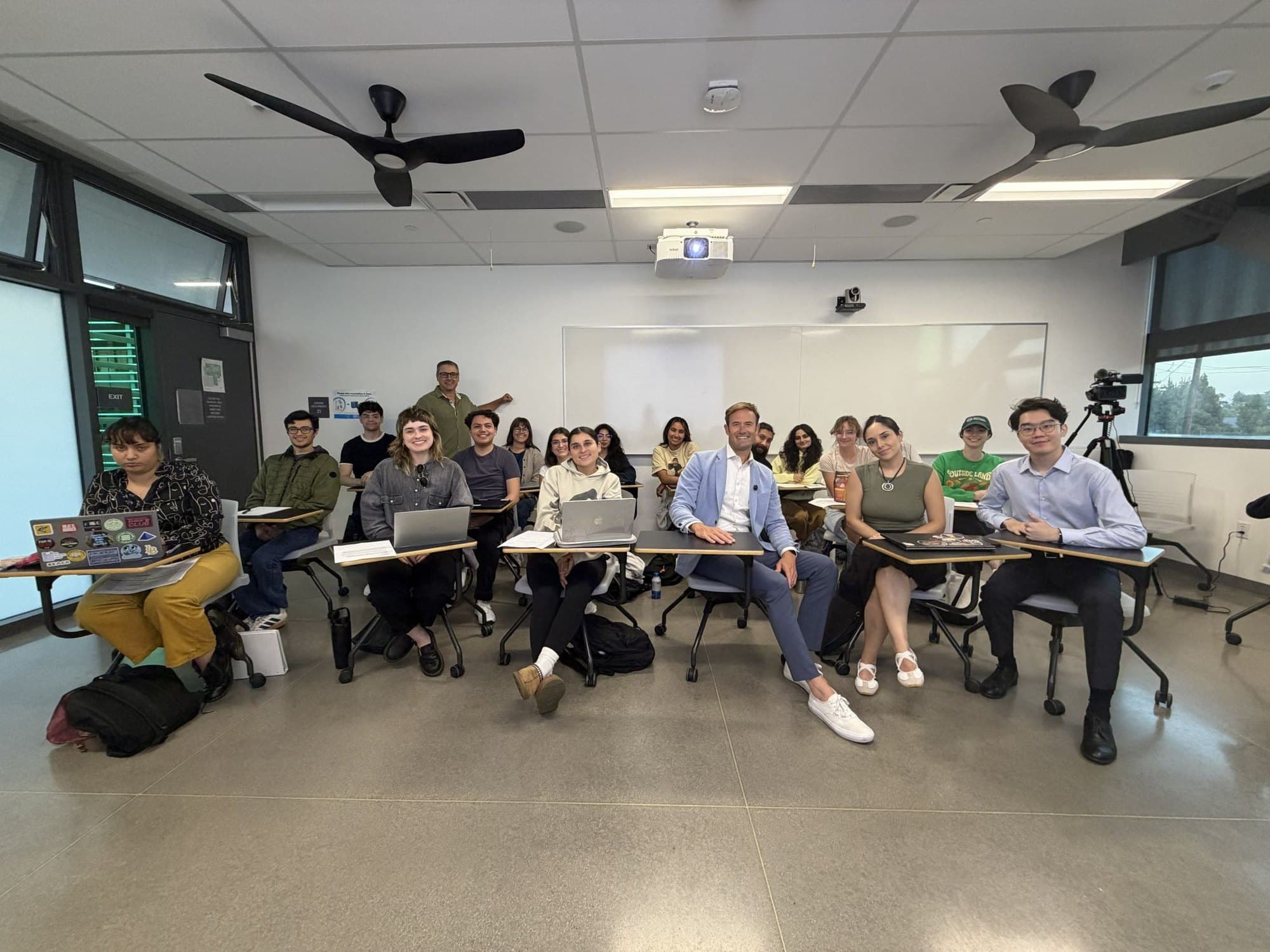
John Shen was already well-known for pushing the envelope when he began discussions that would lead to the Long Beach Accelerator.
Shen had founded American Lending Center, Sunstone Management and other companies in Long Beach, becoming known as a parallel entrepreneur. He would become a member of the Long Beach Economic Development Commission, and was advocating for small businesses as job creators.
“I have long believed that a tech accelerator is the most efficient program to foster the growth of early-stage startups. It also serves as an effective investment tool for investors to target and select disruptive companies that have the best potential to experience explosive valuation growth in the future.”
Accelerators — where startup entrepreneurs get help with business formation and growth strategies as well as initial investment — had been around for some time sponsored by large investment groups. Y-Combinator on the West Coast and Tech Stars (started in Colorado but now in New York City) have been the most prominent.
Shen began exploring opportunities for venture capital investment in Southern California. An accelerator seemed the logical path, but it didn't seem to make sense to take it on by himself. More resources were needed. That could only be done through a partnership.
In the Beginning
John Keisler was the director of Long Beach's Economic Development Department in 2015, guiding the first Blueprint for Economic Development to completion and approval by the City Council. One of the Blueprint recommendations was to partner with a private capital investment firm to create an accelerator to attract new technology companies.
“One day he came into my office and asked me if I could help him find some technology startups in Long Beach because he was offering to have his clients invest in them. Our meeting was synergistic, with perfect timing. We agreed to work together to fulfill both our goals.”
Keisler told Shen that they needed to involve an academic partner to provide educational support and mentoring for startups, and introduced him to Dr. Wade Martin, Director of the Institute for Innovation & Entrepreneurship at California State University, Long Beach.
Dr. Martin taught economics at CSULB, and used the Institute for Innovation & Entrepreneurship as an incubator to help students hone their business concepts, including potential business plans. He said he knew they needed to take the next step if their dreams were going to become reality, but that there weren't resources at the time.
“It is not an overstatement to say that the Long Beach Accelerator would not exist without the vision and commitment of John Shen. It is easy to say, "wouldn't it be nice if…" but if you don't have someone with the willingness to commit the necessary resources and understand that there will be bumps in the path, the vision isn't going to happen.”
These men provided the foundation of the Long Beach Accelerator. By 2019, a nonprofit had been incorporated, a board selected, and staff hired.
The concept took the public-private partnership model a step further, likely for the first time in the country. Now it was a public-private-education (PPE) partnership leveraging the power of all three parties to provide community support and operational resources.
Ramping Up
In 2020, the COVID-19 pandemic stalled the LBA's momentum along with most of the rest of the economy. It might have been a blessing in disguise. By the time they were ready to recruit the first cohort of startup entrepreneurs, the training program had been completed, mentors brought on board and a package of direct and in-kind support completed.
That training was packed into a 12-week schedule. The first three months involved workshops and mentoring to determine market fit, business strategy and development, and sales and marketing. The program's last month focused on developing an exit strategy and preparing for a demonstration day designed to attract additional seed funding.
On Feb. 15, 2021, the first cohort of startup entrepreneurs walked through the LBA doors. There were seven businesses, with most led by a team of founders, and several sectors represented. Three of the seven — Evolectric, Ocra (originally ParkPlace) and Ownors AI — have grown over the last four years and have continued to raise money. A fourth, Storybolt, remains active as well.
Dr. Martin was the first board chair for LBA. He has followed the cohort members — there have been 46 cohort companies before the LBA paused training in late 2023 — to see how they fare in the real world. He offered this:
“The primary factors that I think contribute to their success are: they understand their customer and what they want; they are willing and able to pivot when the market changes; and they are "coachable" — they work well with mentors and they network with other industry experts that lead to additional perspectives on their market challenges. Essentially, these founders are out there and engaged, therefore, they are always learning.”
John Shen's involvement through Sunstone provided initial investments to cohort members. And Sunstone has continued to help those businesses still in their portfolios with everything from networking to connections for technical assistance.
“LBA companies are early-stage technology companies with seed investment from our investment partner, Sunstone Management. For most of our companies, the Sunstone investment is the first investor. We credit their success to several factors — participation in the LBA Business and Management Education program with follow up advisory services and founder participation in other technical accelerators, and experienced founders and executive teams with industry connections and depth of technical expertise to develop their services and platforms.”
Mechanics of the Partnership
When the Long Beach Accelerator was incorporated in 2019, John Shen committed to invest up to $100,000 per year into LBA cohort companies through Sunstone. The City of Long Beach committed $25,000 a year, primarily for office and class space. The CSULB Institute for Innovation & Entrepreneurship contributed expertise as well as acting as a pipeline for startup founders.
The Sunstone seed money typically has been the first investment for most LBA cohort companies, barring family and friends support. Once the cohort has completed training, a Demo Day takes place to showcase the companies to potential investors — Sunstone has the option to increase its investment in return for a small percentage stake in the company's equity.
Sessions consist of lectures and workshops with sector experts, scholars, and specialists to determine market fit, business strategy, sales and marketing. Mentors work one-on-one with founders on everything from the basic business concept to growth and exit strategies.
For the first six cohorts, startups spanned the gamut of service and product verticals, from EVOlectric's conversion of gas and diesel trucks to electric vehicles to Ocra, a centralized real-time channel management platform for parking operators and owners to allocate paid parking inventory to maximize profit.
After completion of the sixth cohort in November 2023, it was decided to pause training. Many of the LBA companies were working through the trough of the "J Curve" business path, where there is an initial period of decline or losses. Investors are watching carefully to see which companies will come out of the trough to profitability and growth.
Moving Forward
While Sunstone, the Long Beach Accelerator and the Institute for Innovation & Entrepreneurship all continue to support the startups that have gone through LBA, the accelerator's board is refining plans for the future.
“With two of the largest ports in the world, more than 30 aerospace and space companies, and a strong healthcare services system, the LBA looks to focus on the verticals of transportation/logistics/supply chain, aerospace/space, healthcare services, energy and clean tech, and creative tech services. With the City of Long Beach a primary host of the 2028 Olympics, the LBA looks to engage global travelers in the Long Beach Tech Ecosystem. The Long Beach Accelerator has a global vision and is making local impact!”
Keisler said that Sunstone Management will continue to be a strong partner, and may look at creating a parallel fund specializing in the proposed verticals at LBA. He noted that goods movement and clean energy generation are expected to be prime areas for advancement in Long Beach and Southern California.
That means fields ripe for startup companies and entrepreneurs — with help from the Long Beach Accelerator.
News Briefs
Clean Energy. One of the largest solar and battery power plants in the U.S. is now providing 7% of the electricity for the city of Los Angeles. The Los Angeles Department of Water and Power partnered with Arevon Energy to build the $2 billion project in Kern County. DWP has committed to a 25-year contract to buy power from the plant, with options to buy the facility outright.
AlphaStruxure, a partnership of Schneider Electric and Carlyle, is constructing a 10.5 MW microgrid to power the New Terminal One at JFK International Airport. It will be the largest rooftop solar array in New York City and the largest clean-energy microgrid at any U.S. airport. Construction completion is expected in early 2026.
Wildfire Mitigation. The USDA and Sierra Pacific Industries launched a $75 million P3 project constructing and maintaining 400 miles of fuel breaks in California's national forests, expanding protection against wildfires.
P3 Pipeline Grows. In 2026, California has more than 20 major P3 projects in planning or procurement in areas including water, transportation, energy, affordable housing and more. Early private partner involvement and acceptance of unsolicited proposals have created a more dynamic environment for partnership.
Sources
John Shen, Crossing the Swamp, pages 15, 142 and 143.
Altar.io, "Best Startup Accelerators in the USA" — https://altar.io/best-startup-accelerators-usa/
Long Beach Accelerator — https://www.lbaccelerator.org/